








While anime has a reputation for indulging in science-fictional spectacle, it is not a medium renowned for its realism. Bombastic mecha battle sequences, espers from space, and computers possessed by ghosts, while all potentially fantastic story elements, are not in keeping with the detailed and accurate approach to the possibilities of science and technology explored by proponents of hard SF. Anime and manga are visual art forms, and their creators need not limit themselves to the strict confines of scientific possibility or probability when imagining terraformed planets and alien species. Storytelling based on hypothetical or purely speculative analogies can be just as effective as realism when addressing societal, philosophical, and psychological themes.
And yet, given the excitement and optimism generated by NASA’s latest mission and the popularity of the newest blockbuster based on an Andy Weir adaptation, people seem hungry for plausible science fiction again. While escapism is always welcome, given the uncertainty that dominates many of our daily lives in 2026, grounding that escapism in reality provides a curious comfort: Reality may be chaos, but at least there can be a little order, competence, and consistency in our fiction.
Hard SF is typically defined as fiction in which the depicted technology is, if not entirely feasible, supported by established scientific principles and real technical research. And while people love to quibble about the precise parameters of hard SF until the cows are abducted, here are a few anime gems that should appeal to fans of the genre…
For all those broken astronaut dreamers: Space Brothers
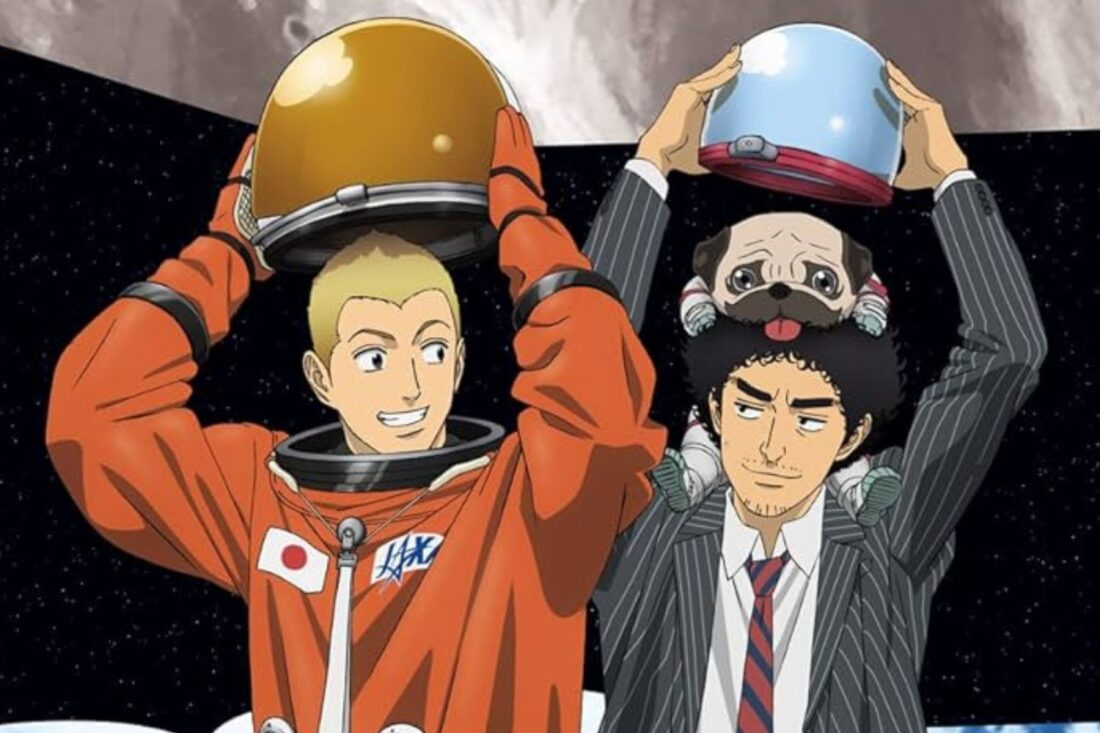
I have seen it argued that Space Brothers barely qualifies as science fiction because it is too realistic. After all, it is a series about two men pursuing their dreams with the help of a real-world space agency—JAXA, Japan’s NASA equivalent—and, for the most part, the series rarely develops technology beyond that which we have seen in the real world.
But I have a question for anyone who wants to categorize Space Brothers as slice-of-life rather than sci-fi: In reality, when did the first Japanese astronaut land on the moon?
The answer? Never. JAXA has never sent an astronaut to the moon. Right now, the first Japanese astronaut is expected to achieve a lunar landing in 2028 as part of NASA’s Artemis project. Arguably, suggesting an anime about aspiring Japanese astronauts is more “slice-of-life” than sci-fi ignores the fact that space travel remains an inaccessible dream for most of the world’s citizens. As of 2026, only three nations maintain active, self-sufficient spaceflight programs. Currently, JAXA employs only five active astronauts.
Space Brothers chronicles the lives of the Nanba siblings, Mutta and Hibito, who are pursuing their astronaut aspirations. After witnessing a potential UFO as children, they set their hearts on space. But while Hibito, the younger brother, reaches his goal in record time, Mutta finds himself stuck in an office job, proud but envious of Hibito. After he’s fired for crashing out at work when his shitty boss mocks Hibito, Mutta finds himself adrift. With the support of his family, he finally commits to his abandoned dream and begins training to participate in JAXA’s selection program.
The JAXA in Space Brothers is probably the JAXA Japan wishes it had, well-funded and acclaimed, on equal footing with NASA and Roscosmos. Mangaka Chuya Koyama recreates JAXA’s facilities with loving accuracy, ensuring that Mutta’s experience is a vicarious adventure for those of us who dreamed of Space Camp but could never afford it.
But this is a manga that has run for almost twenty years now, and its characters’ ambitions are larger than life. While Hibito aims for the moon, Mutta aims for Mars. In our world, Mars remains out of reach for all but robotic rovers. But in the meticulous journey that is Space Brothers? That may not be the case.
Mutta’s aspirations may feel completely unattainable at first, but he’s a character who trudges, steadfast, towards his goals until he can almost scrape them with his space-suited fingertips. It is precisely because Space Brothers keeps one foot planted on Earth that it feels so inspiring: If Mutta can do it, maybe we all can.
For all those disappointed with tech: Dennou Coil
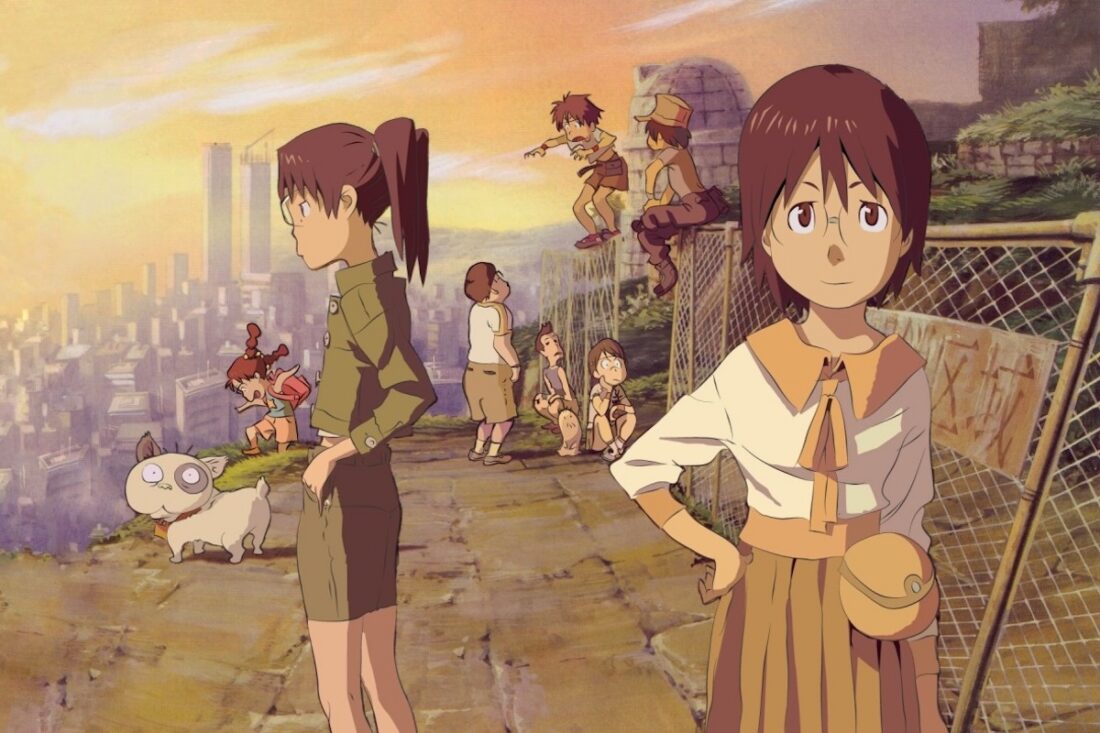
Dennou Coil is that rare anime that’s more popular with genre geeks than actual otaku. A nondescript art style, reminiscent of the works of Naoki Urasawa, a cast of middle school girls, and its early categorization as an edutainment title may have something to do with how often it flies under people’s recommendation radar. In the two decades since Dennou Coil aired, it has cultivated a reputation for being far ahead of its time on a technological front.
Dennou Coil features arguably the single best depiction of augmented reality in anime. Set in the sort of near-future that Google Glass promised but failed to deliver, Dennou Coil tells the story of Yasako, a young girl who moves to the historic fictional city of Daikoku. Daikoku is home to a corporation called Megamass, which is responsible for manufacturing the AR glasses that humanity has come to rely on. Yasako and her peers regularly view the world through cyberglasses, and are as comfortable playing with cyberpets and cybermatter as most kids are with playgrounds or, well, iPads.
However, the kids begin to question cyberspace’s role in their lives when bizarre occurrences in cyberspace begin to impact reality. A friend may have died due to an AR interaction, and an urban legend about an illegal, shrouded entity in the Den-Noh (cyberrealm) proves to have a basis in fact.
Themes of corporate surveillance, profiteering from human socialization, the invasion of privacy, and more are explored with insight. Dennou Coil also addresses technology’s impact on the human psyche and memory, and highlights the human tendency to anthropomorphize inhuman inventions. Children are imaginative, and when imagination is applied to a false reality, what’s to stop urban legends from manifesting? What is reality if the world, like our memories, begins to exist only in an intangible sense? Anime fans with an urge to dive into the philosophical repercussions of tech could ask for no better starting place than Dennou Coil.
For all those considering humanity’s cosmic impact: Planetes
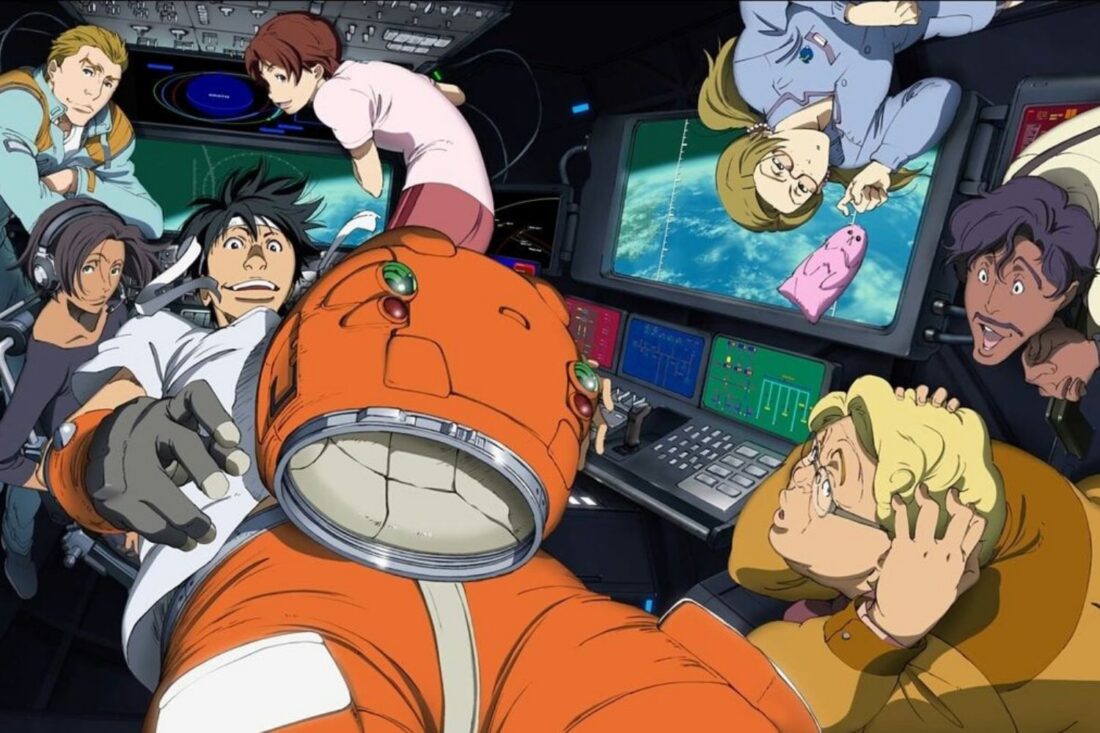
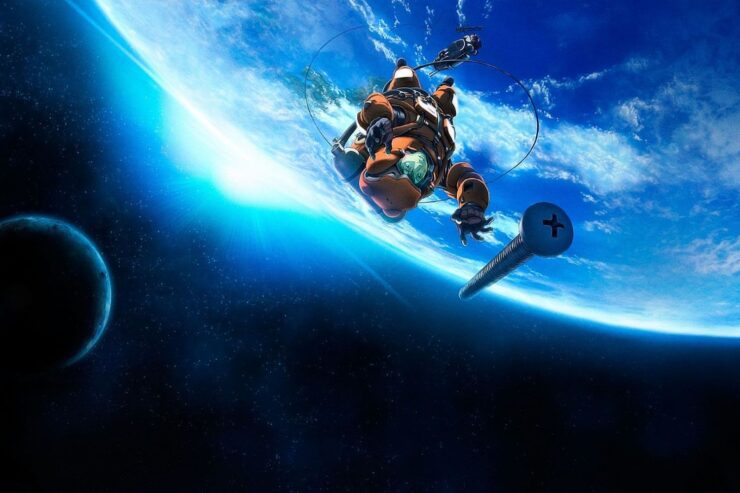
Old but gold, Planetes is held in high regard by sci-fi fans. While its mangaka has somehow gone on to conquer even greater heights with his recently concluded historical epic Vinland Saga, one of Makoto Yukimura’s strengths, regardless of genre, is his hyperfixation on accuracy. Planetes is a work preoccupied with portraying a convincing future in painstaking detail, imploring its audience to take it seriously.
Planetes chronicles the lives of several astronauts aboard the DS-12, aka the Toy Box, a ship whose purpose is to dispose of space debris caught in Earth’s orbit. To prevent catastrophic collisions with active ships or the Earth itself, the crew must dispose of defunct satellites and other flotsam cluttering the exosphere.
In the course of their work, the main cast contends with a wide range of personal and professional challenges in addition to corralling space junk. A Russian widower searches the ether for a watch that belonged to his wife before a deadly collision with space debris ended her life. The ship’s American commander faces off against a terrorist organization that believes humanity is overreaching without considering the consequences of careless space exploration. The Japanese son of an acclaimed engineer, determined to be his own person, joins the crew as a specialist in extravehicular activity and successfully rescues a crewmate; however, he subsequently develops a mental disorder that impedes his ability to work. There are human stories at the core of this space adventure.
Yukimura first came across the concept of space debris while browsing in a library, and from that starting point imagined a future in which humanity would have to deal with the consequences of pollution even beyond its own planet. He aimed to document the lives of real people in a futuristic setting, without bells and whistles, and tell a complete story. While the anime aired before the manga was finished, he eventually accomplished that goal. Planetes remains exemplary, a perfect illustration of how meticulous worldbuilding can create an excellent vessel for exploring humanity’s strengths and flaws.
For all those disenchanted by AI: Time of Eve
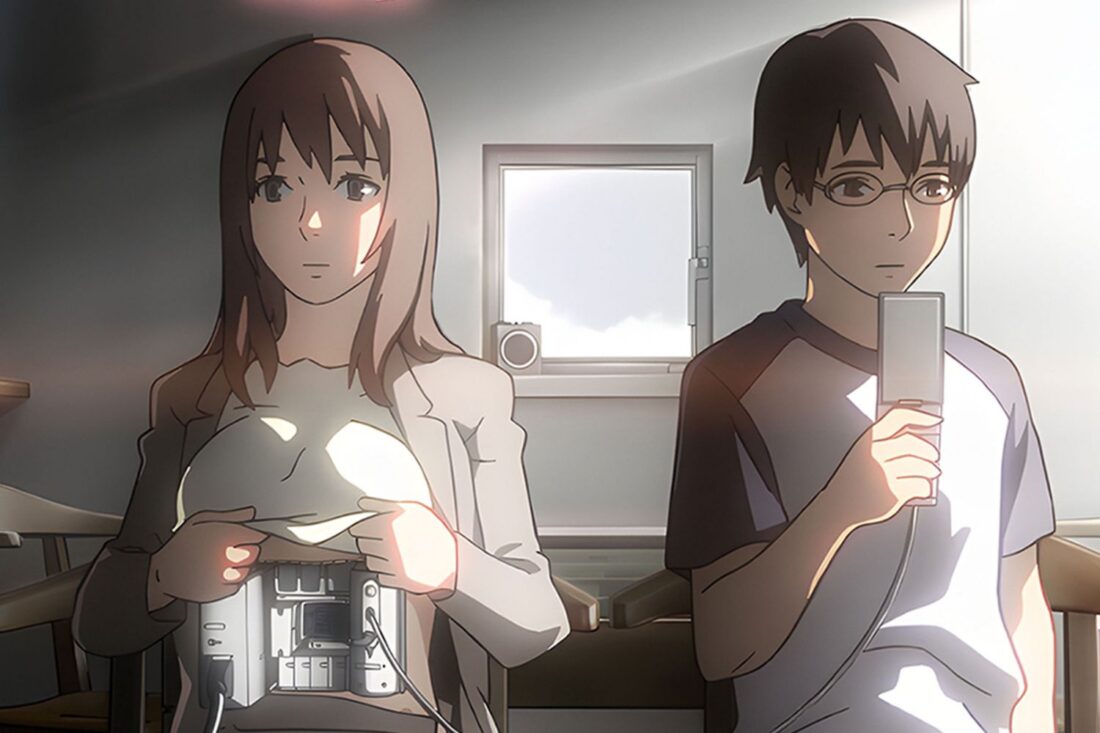
Time of Eve is an odd duck. Originally an ONA series consisting of only six relatively short episodes, was very much the passion project of writer and director Yasuhiro Yoshiura. Produced by his own little studio and another company primarily responsible for creating educational programs for children, Time of Eve was among the first anime series to be streamed online rather than broadcast on television. On a superficial level, the show is unremarkable, its character designs bland, its color palette muted. But Eve doesn’t need to be flashy to leave an impact.
The Time of Eve is the name of a basement cafe patronized by both humans and androids. Taking direct inspiration from the work of Isaac Asimov, the series is set in a world in which artificial intelligence is less about brain rot and more about household robots serving human beings, constrained by the three laws. But regardless of their roles in the world by day, after hours at The Time of Eve, androids need not identify themselves as such. Under dim light and the comforting cloak of anonymity, frank conversations between human beings and this newer, manmade species can take place free from observation or judgment. Discrimination is forbidden within the establishment.
Because episodes take place primarily within the cafe, the anime has the claustrophobic feel of a very long bottle episode. But the burgeoning sovereignty of the androids and the questions they inspire are always compelling. Have androids already surpassed human beings when it comes to perfecting music, or is the discouraged human pianist giving up too soon? Can androids lie to human beings without breaking the terms of their existence? If human beings cannot determine who is human and who is android, can androids?
There are many anime that address the philosophical ramifications of artificial intelligence, but Time of Eve does so in a way that is both understated and deeply effective.
It feels a bit dangerous writing about hard science fiction for a publication like Reactor. I’m confident discussing niche anime and yokai, but I may not have the genre expertise to declare beyond a doubt which series will satisfy the most exacting fans of Hard SF and which will fall short. Even so, I am confident that there are other examples of speculative anime that challenge the mind while building on a foundation of scientific and technical accuracy. I appeal to the expertise of readers on this front—please share your own recommendations, because sometimes it helps to remind ourselves that scientific innovation can be so much more than a tool for profit and the cause of human suffering. I miss seeing science as a path to the stars.

Yay, more anime to track down. Although I did know about Planetes.
There was a 2007 anime called Rocket Girls, based on the light novel series of the same name. SSA, a private space company ,could not get their large booster to launch without blowing up. Once they determined their adult, male astronaut was not willing to let them surgically whittle him down to fit the smaller, reliable booster, they hired a teenaged girl who happened to be on the island with the launch facility. As one does.
Her fee was to be the company’s help finding her long-lost father… whose location they knew perfectly well, as he was now the leader of a local tribe of natives whose culture was, I suspect, determined entirely by narrative necessity rather than any sort of anthropological research.
Touring After the Apocalypse is probably Hard SF? It’s set after events develop not necessarily to the benefit of Japan or the world in general, as two teens (one probably human, the other a cyborg) tour the ruins of Japan after the radiation from the not clearly explained in the parts I read died down. It’s all very cheerful and life affirming,when they are not running for their lives.
I have not watched the anime but can highly recommend the first novel (Nojiri Hōsuke is the author’s name and it’s available in an English translation). I have read that the anime veers into the cute-girls-doing-cute-things genre but I have not seen it myself.
I think the basic plot (offshore private space firm sends a minor into space so they can keep their government contract) feels a lot more grounded today than it probably seemed in 1995.
I don’t think I’ve ever seen movement in microgravity depicted as plausibly as Planetes did it, at least not at series length (there have been a few movies that did it quite well, like Gravity and the 2017 Life), although I think they exaggerated the lightness of Lunar gravity in the first episode set there. Unfortunately, I didn’t like the stories or characters as much as I liked the science and setting. Oh, and it’s worth noting that while the science was accurate, the geopolitics relied heavily on fictitious countries and international entities, at least in the anime (I don’t know about the manga).
It’s a bit off-topic, but I find it interesting how there seems to be a trend in fantasy anime to depict worlds where magic is approached with a scientific mindset. In Frieren, the new Witch Hat Atelier, and even The Red Ranger Becomes an Adventurer in Another World, a lot of the storytelling is driven by the characters studying or explaining how magic works and devising new techniques for its use, treating magic as a practical applied science or technology that follows logical, knowable rules rather than an arcane mystery that does whatever the writer finds convenient. So even though it’s fantasy, it gives me the same kind of satisfaction I get from science fiction driven by creative problem-solving and studying the workings of the world.
It’s been a long time since I watched Planetes, so I don’t doubt the fictitious countries bit, but I also wonder if that was an anime thing more than a manga thing. Only because that mangaka loves nothing more than accurate details. Vinland Saga is so lush with history that I devour every millimeter of its panels!
As for that fantasy trend — I totally agree, and wonder if people are charmed by the fantastic elements and soothed by the reasoning. Another series that does this wonderfully is Dungeon Meshi, which I wrote about some time ago.
Time of Eve is very beautiful!
I agree. The closest thing I’ve seen to it thematically is Vivy, but that’s a lot flashier. Eve has the same understated charm as Haibane Renmei or Kino’s Journey.
I was really impressed by the 6-part series, The Orbital Children (2021), streaming on Netflix. The physics of an orbital habitat, pressure issues, and the physiological problems associated with children born in lower gravity are a good setting; the greater story involves AI at a sometime-in-the-future singularity. It’s a follow-up by the same director as Dennou Coil, too.
I had no idea that was made by the same creator as Dennou Coil! I will look into it. Thanks for the recommendation!
I’d forgotten that one until you mentioned it. I was struck that both it and Godzilla: Singular Point, another Netflix anime from 2021, were both ultimately about artificial superintelligences doing the critical world-saving work while humans merely supported and facilitated their efforts. (The Japanese title translates literally as Extraterrestrial Boys and Girls.)
I would consider Ghost in the Shell and many of the anime it inspired to be hard sci fi. Dennou Coil sounds interesting and I’ll definitely check it out. Sounds like it might have a Serial Experiments Lain vibe.
If one is willing to accept ‘mecha are possible’ I would recommend Patlabor. The basic plot is that if mecha were a mundane part of society (an example would be use in construction) then law enforcement would be issued mechs. It’s presented in a very down to earth fashion. Mechs are small, and they aren’t flying around (in fact they have to be pulled on a semi trailer and charged up on site), and the characters are typical cops not some elite special forces.
There was this genre shift kicked of by ‘79s Mobile Suit Gundam called ‘real robot.’ The contrast is with the earlier ‘super robot’ genre where the mecha were essentially powered by magic. Voltron is a good example of a super robot show.
How ‘real robot’ a mecha show needs to be to be considered hard sci I think mostly comes down to how you want to define hard sci fi. But I think there is definitely a hard sci fi to fantasy sci fi spectrum in mecha anime, even if a person’s definition of hard sci doesn’t allow for the basic conceit.
In the Gundam franchise I would put the 08th Mobile Suit Team as the most grounded (and a great franchise starting point). Outside Gundam, Knights of Sidonia has a lot of verisimilitude, at least around the generational ship aspects. But the mecha in Sidonia are fantastical enough to likely push it out of real robot territory though maybe not out of hard-ish sci fi.
I am terrible at defining Hard SF, which is why I appreciate it but do not write it. I am, however, a fan of many a mecha, and have never seen Patlabor. To be fair, I tend to enjoy more fantastical and weird mecha shows, like Gurren Lagann, Eureka Seven, Star Driver, and Gargantia.
And no one can tell me the scenes in Evangelion when the mechs are being launched aren’t perfectly nerdy mechanical sequences that demonstrate an understanding of engineering.
Heh. I’m not sure I could give an ironclad definition of “sci fi” itself, much less sub categories.
Best I’ve been able to come up while thinking about this discussion is that hard sci fi is when the author uses a STEM element to drive or shape the plot and not just facilitate it. If it’s pretty easy to swap out the plausible elements for fantastical ones then it’s probably less hard sci fi and more general sci fi, but with some hard sci fi chrome. If you pull the STEM elements and there is no story left then maybe that’s hard sci fi. So maybe I just shot down my own Gundam example there but I’m sticking with Ghost in the Shell.
I think that works pretty well for both Space Brothers and Planates. I’m a few episodes into Time of Eve and I think it works there as well. No androids, no story. (Also, it’s good so far so thanks for the recommendation. The default fictional AI apocalypse motivation seems to be “AI thinks it’s superior” when I think “humanity can’t distinguish a tool from a slave” is going to be more likely.)
Authorial intent plays into it pretty heavily too, I suppose. Shirow’s focus was on the philosophical implications of cybernetics, while Tomino’s focus was on how war is getting children to kill each other for the benefit of the rich and powerful. The grounded technology was likely there to counter existing mecha anime tropes. It wasn’t about how the technology impacted society in a plot-driving way.
Time of Eve got me thinking about Yokohama Kaidashi Kikou. In terms of technology YKK and Time of Eve share a lot. But I would not think of YKK as hard sci fi.
Never mind. I have no workable definition. Something, something, STEM, something, near future space travel, something.
RE: Evangelion: Y’know, come to think of it, a questionably necessary catapult launch is a requirement in all mecha anime. If I were to do a ranking of those Evangelion’s would be near the top.
“Best I’ve been able to come up while thinking about this discussion is that hard sci fi is when the author uses a STEM element to drive or shape the plot and not just facilitate it.”
That’s part of it. The Analog Magazine writers’ guidelines define SF as a story that couldn’t be told without the speculative element. But to be hard SF, the science has to be grounded in real science or a logical extrapolation beyond it. Even if you postulate one purely conjectural element or a deliberate change to physical law in order to make the story work (e.g. the reverse-entropy alternate universe in David Brin’s The Practice Effect), you have to illustrate how it would behave in the context of otherwise real and believable physics.
I mean, Star Trek: Voyager‘s “Tuvix” is a classic example of Analog‘s definition of a story that couldn’t possibly be told without its speculative element, a transporter accident combining two people into one and triggering a painful ethical debate about their respective rights to exist. There’s no way you could tell a story like that in mainstream fiction. But the speculative technology is completely fanciful — heck, I’d call it nonsensical even by the usual standards of Trek transporter episodes — so it’s very, very far from hard SF.
Hal Clement, one of the seminal hard SF writers, defined it as a competition between the writer trying to convince the audience that the speculative situation is believable and the audience trying to catch the writer out on the scientific flaws. The goal is to make the fictional premise as convincing as possible even to science-savvy readers/viewers. At least, it has to sound plausible enough that the readers are willing to suspend disbelief, to get enough real science right that it makes the fanciful science feel like it makes sense, at least for the purposes of the story. I like to put it in terms of the old actors’ joke: “The key is sincerity. If you can fake that, you’ve got it made.”
I’m not sure I’d count GitS as hard SF. Maybe the technology is nominally plausible, but I have a hard time believing that people would so readily entrust their entire lives and consciousnesses to a technology that’s so easily hacked. I mean, given the recent frenzy over so-called “AI,” I can buy there being a fad of reckless adoption of the technology early on, but I think the bubble would burst once the dangers and problems of it became clear, and it would end up being used with more restraint and more safeguards.
It’s also rather fanciful when fiction assumes that human consciousness can be straightforwardly equated with ordinary computer software — that it works the same way and can be copied, transferred, programmed, and rewritten the same way. The human mind is a neural network, a distinct kind of architecture that isn’t programmed in the conventional sense but learns through experience and repetition, and that can’t really be exactly copied, since its state is an emergent property of its activity and sensitive to initial conditions, so even if you duplicate the basic substrate, running it two separate times will produce distinct results. So the way GitS and other cyberpunk fiction depicts human minds as software that can be hacked, copied, etc. is basically techno-fantasy.
I can perhaps buy mecha that aren’t impractically large, but I’ve been trying for decades to think up a plausible rationale for large mecha to be bipedal or humanoid in shape, and I’ve never come up with a good one. Even a biped the size of Patlabor mecha would be dangerously unstable; it would be preferable to go quadrupedal at the very least, though something with wheels or treads would probably make more sense. Even if you needed to navigate rough terrain, something with multiple adjustable treads would probably be more stable and practical than a walker. I can only buy a battle suit of human size or slightly larger, like the symbot suits in my novel Only Superhuman.
Certainly anything as large as a Gundam or a Sentai robo (Megazord) is nonsensical, running afoul of the square-cube law and the limitations of structural materials. There was that life-size, moving Gundam statue that was on display in Japan a few years back, and it could only move very slowly. Anything faster would be too dangerous and probably generate too much stress for the materials to endure. And of course, it couldn’t actually walk, since that’s too intrinsically unstable a form of locomotion.
Hey, righteous! I listened to your book via Graphic Audio and quite enjoyed it. Well done with your book.
Definitely agree that Ghost in the Shell is outside the realm of hard sci-fi. I think people say that because it is presented in a more gritty, grounded manner and not as super flashy and shiny as other anime, like Gundam typically is.
I have no issue with consciousness transfer or manipulation, since the human brain is already easily influenced in modern days via psychology and marketing, and books like Old Man’s War present consciousness transfer well. Though I can’t really remember it being explained clearly, just enough to avoid detail picking.
I’ve watched Patlabor and the entire concept is rather silly. It does do a great job of showing the massive logistical issue of such machines, and why such things would indeed be implausible and impractical. Even if the maintenance weren’t such an issue, it is still an extremely complex and cumbersome method of doing anything that it far exceeds their cost-benefit in anything outside of an extremely niche application.
I love mecha, from the old tabletop Battle tech, to Gundams, and more mundane power armor, but I just can’t see how such a platform could ever become mainstream and a primary force in its own right.
I absolutely adore Space Brothers and Planetes. Not just the details, animation, and story, but the passion of the creators that went into it. They even partnered with JAXA to record live audio with their astronauts for the show.
Those 2 shows have not just a setting, but indeed a focus on aspects of space travel that are often completely ignored by sci-fi, yet which are absolutely critical in reality, as they are in the shows. Orbital dynamics and survival, that weightless does not equal massless. These facets are often not just ignored in sci-fi, but utterly trivialized and just plain wrong. But in these shows, it’s RIGHT.
I crave such media, and there is precious few, even outside anime, that manage to walk the line between sci-fi and fiction. That respect the hard science of space.
For any fan of space travel, Space Brothers is the very standard against which all other anime is measured. Planetes is superb, but comes in second due to leaning into more “what if…” And taking a more spectacular story.
I think what also sets Space Brothers apart is the human element. Those are great characters that really deserve good things, and it’s wonderful to go on the challenging journey with them. Their love for space is infectious, and reminds me of being a starry-eyed kid.
I recommend Bodacious Space Pirates. It won a Seiun Award (similar to the Hugo) in 2013 for best dramatic presentation. It’s a bit silly, but much of the sci-fi elements have a basis in real (and theoretical, hopeful) science.
You have no idea how close I came to mentioning that show, because my co-conspirator and grab-bag comrade Bridget adores it and has cosplayed as the lead!
That just makes me think you and your co-conspirator need to write a full article about it 😉
Where is Gundam.
Nice inaccurate list here.
oof, way to lean into the Gundam fan stereotype.
I like Gundam. But it is far from Hard SF.
The giant robots were always fanciful, but at least the early Gundam series drew heavily on Gerard O’Neill’s The High Frontier and its proposed space habitat designs. I used a Gundam fan site about the science of the series as a reference for the Asteroid Belt habitats in my novel Only Superhuman, along with The High Frontier itself, NASA proposal papers, and so forth.
https://www.dyarstraights.com/gundam-test/
Although I’d never actually seen the series at the time, and when I did try it out a few years back (at least the movie-compilation versions of the original series), it didn’t hold my interest.
I think the compilation movies are good if you have already bought in to the franchise and want to skip ahead but I don’t think they are a good entry point. My go-to recommendations (based on “short” + “great”) are War in the Pocket (6 eps), 08th Mobile Suit Team (12 eps) and The Origin (6 hour long episodes or 12 cut up into parts). To keep this tangentially on topic for this article I think those are all on the “harder” end of the spectrum. But as a franchise I think most shows are more science fantasy.
There’s a hard sf series called Moonlight Mile, about 2 men who go into space to help bring a new clean energy to Earth, one as a construction worker (in space), and another as a space pilot. It’s about 20 years old. It was never very popular so I don’t know if anyone could find it. The manga is still around I think.
I liked Space Brothers the best. Though Bodacious Space Pirates was the most fun, and surprisingly decent about the science.